

Managing multiple income streams, working under flexible contracts, or operating as an independent professional offers immense freedom, but it also adds a technical hurdle when handling cash flow. When your revenue shifts drastically every 30 days, traditional, rigid budgeting spreadsheets simply fall apart.
Most people try to guess how much cash they will pull in next month and build a spending list around that hypothesis. However, for those operating within a variable income environment, that forecast rarely aligns with reality. This is exactly why mastering how to organize monthly budget metrics through Zero-Based Budgeting is a complete game-changer.
In this guide, you will learn how this method gives an explicit purpose to every single cent that hits your account, allowing you to shield your wealth without living on the edge.
What is Zero-Based Budgeting?
The core premise of Zero-Based Budgeting is incredibly straightforward yet remarkably powerful: every dollar of income that flows in must be completely allocated until your remaining balance equals exactly zero.
This does not mean you spend all your money until your bank account is empty. It means that every single dollar hitting your account needs to be assigned a specific “job” or destination before the month unfolds. If you earned $4,000 this month, you must assign exactly $4,000 across fixed expenses, investments, savings benchmarks, and personal leisure. At the end of your calculation, your unallocated balance must be zero.
Why is it Perfect for Freelancers and Contractors?
Unlike standard budgets that peer into the future based on mere assumptions, Zero-Based Budgeting works strictly with the money that is already sitting in your account today.
If you experienced a highly profitable month and brought in exceptional revenue from your side hustles, you sit down and allocate that tangible cash. If the following month turns out to be slower, you distribute a smaller pool of resources, prioritizing what is strictly vital. You never spend capital you hope to receive; you only manage the capital you have already secured.
Step 1: Log Your Available Cash (And Only the Real Balance)
To begin organizing your upcoming month, check the exact balance available for use right now (originating from payments cleared during the prior month). Note this number down at the top of your page or spreadsheet. This is your baseline starting point.
If you carry multiple income streams, centralize these incoming payouts into a single primary cash flow account before you start distributing them. This prevents small tracking margins from getting lost across various digital wallets or merchant apps.
Step 2: Cover the Four Pillars of Survival
Before thinking about long-term investments or non-essential lifestyle spending, your cash must secure your household’s baseline stability. Allocate your initial blocks of capital to the “Four Pillars”:
- Housing: Rent or mortgage payments, basic community association fees, and core utilities (water and power).
- Food: Essential grocery store shopping (exclude dining out here).
- Transportation: Fuel, public transit fares, or core financing installments and insurance for your work vehicle.
- Basic Protection: Your non-negotiable health insurance premiums and professional liability lines.
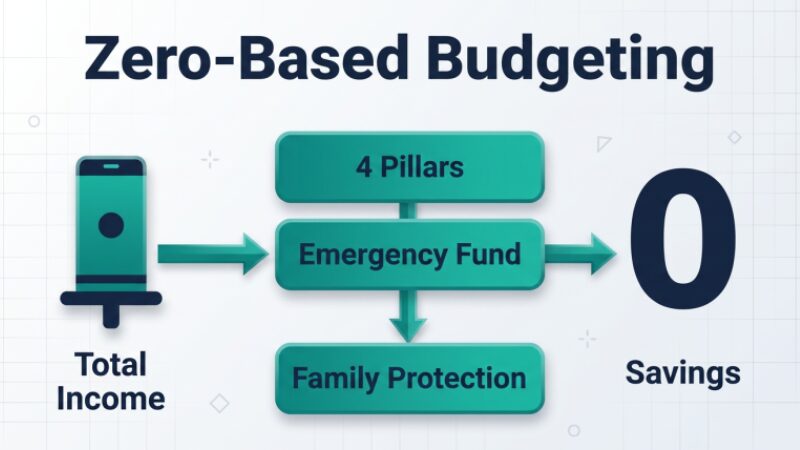
Step 3: Command the Destiny of the Surplus (The Outflow)
Once your core fixed items and variable everyday costs are fully mapped out for the month, you will likely still see a positive balance on paper. This is exactly where the strategic shielding takes place. If you leave this surplus sitting idly in a transactional checking account, it will fade away into impulse purchases.
Give an active command to that remaining cash. Distribute it intentionally across:
- Accelerating your liquid High-Yield Savings emergency funds;
- Securing consistent contributions toward asset protection or retirement accounts;
- Paying down high-interest structural debts.
If your final math equation matches exactly zero after assigning every dollar, congratulations: your monthly layout is perfectly organized.
Absolute Command of Your Cash Flow
Learning how to organize monthly budget layouts via the Zero-Based model completely removes the underlying anxiety of wondering whether your funds will last. You transition into commanding your money, instead of letting your financial liabilities command you.
Developing this precise clarity over your cash flow is exactly what lets you know the precise moment you can comfortably invest in better professional tools for your business or scale up your defensive insurance mechanisms to shield your achievements long-term.
🛡️ Shield Your Budget with ShieldPocket
Practical organization is the baseline foundation of your long-term financial safety. Want to learn how to seamlessly weave your savings benchmarks and asset protection insurance into a dynamic budget layout?