

Transitioning from traditional corporate W2 employment to navigating self-employment in the US as an independent 1099 contractor delivers an incredible sense of career freedom. You gain schedule flexibility, autonomy in client selection, and, more often than not, the gross amount on your weekly payout appears significantly larger.
However, the primary financial hazard of operating under the 1099 model is an optical illusion. When your check clears or direct deposit lands in your account, the funds arrive completely unadjusted — without any tax withholding applied at the source by your client.
If you spend that gross payout assuming it represents pure net profit, you will face a harsh reality check early the following year during tax settlement with the IRS and state authorities in the form of back taxes and steep penalties.
In this practical blueprint, you will master the exact methodology to organize your cash flow, calculate your tax reserves, and insulate your financial foundation as an independent 1099 earner in America.
What Does Receiving a 1099 Form Mean?
In the United States, when you perform services as an independent contractor or freelancer, hiring companies do not classify you as a traditional employee; rather, they treat you as a separate business entity providing commercial services.
At the end of the tax year, instead of issuing a W2 form, hiring entities provide you with a 1099-NEC form (or 1099-K, depending on payment processors utilized). This official document reports to the IRS the exact gross compensation distributed to you.
The direct financial consequence is that you assume absolute responsibility for calculating and remitting your income tax alongside the Self-Employment Tax (which funds Social Security and Medicare, covering both the employee and employer portions).
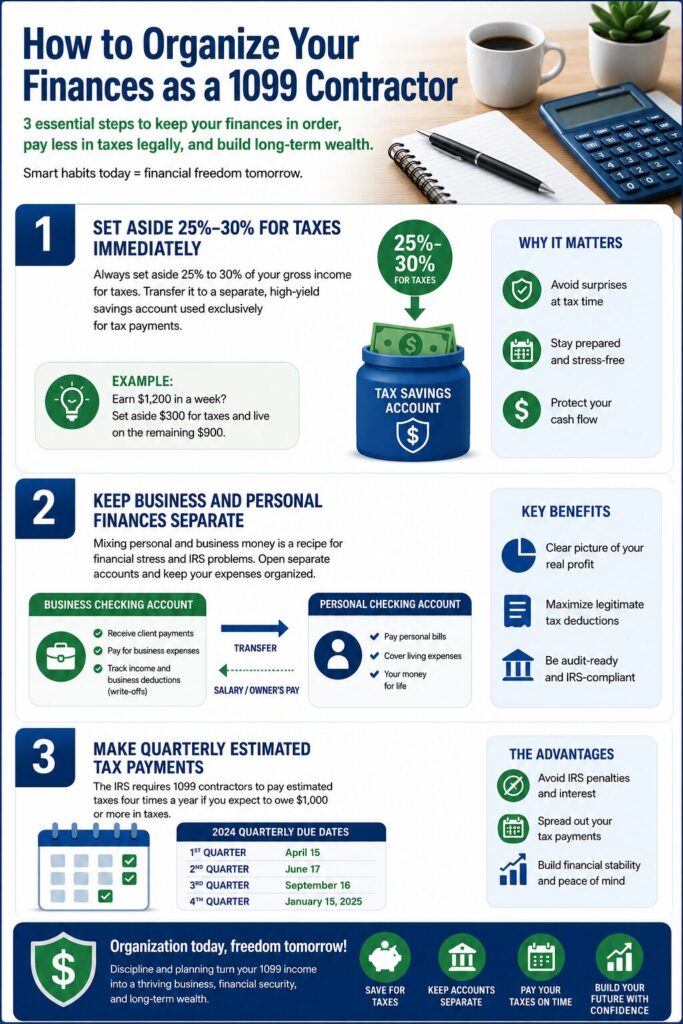
Step 1: Enforce the Immediate Tax Separation Rule (25% to 30%)
The non-negotiable golden rule for self-employed individuals in the US is simple: the gross funds deposited into your account do not fully belong to you.
Whenever you receive a weekly settlement or close out a project invoice, partition the gross sum immediately. Route 25% to 30% of the payment directly into a separate high-yield savings account dedicated exclusively to your upcoming tax liabilities.
- Practical Example: If you clear $1,200 in gross weekly payouts, sweep $300 directly into your tax reserve bucket. You cover your baseline personal living costs strictly out of the remaining $900.
Executing this transfer on a weekly cadence completely eliminates tax season panic and neutralizes unexpected liabilities with tax authorities.
Step 2: Fully Segregate Personal and Business Ledgers
Commingling work vehicle fuel, tool purchases, and personal household groceries within a single primary checking account creates accounting chaos and leaves you vulnerable during a potential tax audit.
Establish an independent business checking account dedicated strictly to your 1099 operational activities:
- All incoming client payments enter this business account.
- All legitimate operational expenses (work vehicle gas, specialized gear, trade tools, software, business phone lines) are paid directly from this account.
- You execute planned owner transfers as your “personal salary” into your personal checking account.
This clear separation allows you to track all eligible tax write-offs. Every verified business expense reduces your overall taxable net income, lawfully lowering your tax burden.
Step 3: Submit Quarterly Estimated Tax Payments
Unlike W2 workers who have taxes automatically withheld from every paycheck, the IRS requires self-employed individuals projected to owe over $1,000 in annual tax liabilities to submit Quarterly Estimated Taxes.
These quarterly deadlines typically land in April, June, September, and January.
Remitting these micro-payments throughout the year using your dedicated tax reserve vault prevents late-payment penalties from the IRS and breaks your tax obligation into four manageable installments across the year.
Financial Organization That Secures Long-Term Prosperity
Mastering the mechanics of self-employment in the US under a 1099 framework converts a complex administrative burden into a sustainable competitive advantage. Automating your tax withholdings and isolating operational overhead grants clear visibility into your business’s true net profit margins.
Organizing your cash flow as a 1099 contractor builds the baseline launchpad to scale your earnings in America. Once your daily expenses and tax reserves run smoothly, your next strategic move is insulating that income against medical emergencies and disability risks.
🛡️ Shield Your 1099 Business Operations with ShieldPocket
Operating as an independent contractor in the US requires a private safety net, as you do not receive corporate benefits. Want to discover how to protect your income against injuries, set up effective health coverage, and secure a tax-advantaged retirement plan?