

Launching a targeted blog project centered on affiliate marketing and monetization is one of the most intelligent strategies to engineer a long-term passive income digital asset. However, the vast majority of beginners make the exact same fatal mistake within their opening weeks: selecting an overly broad topic or targeting high-competition verticals without a strategic roadmap.
Attempting to launch a fresh blog covering “General Finance” or “Health and Wellness” forces your new domain to compete directly with massive enterprise media portals carrying multi-million dollar budgets. The secret to scaling quickly and triggering your first affiliate commissions lies within the micro-niche.
In this practical breakdown, you will master the exact framework on how to choose a niche for affiliate marketing, ensuring rapid topical authority on Google and converting casual readers into active buyers.
The Golden Triangle Rule of Niche Selection
For an affiliate blog niche to be viable and highly profitable, it must strictly sit at the intersection of three non-negotiable structural pillars. If any single pillar is missing, your project will struggle to gain organic traction:
- Passion or Practical Knowledge: You must genuinely enjoy or understand the topic enough to produce (or audit) dozens of high-quality articles without abandoning the project by month three.
- Organic Search Demand (Google Search Volume): There must be real people actively searching Google daily for solutions, troubleshooting guides, and product recommendations in that vertical.
- Commercial Intent (Affiliate Programs): The overarching topic must connect directly with physical or digital products offering established affiliate programs with strong commission margins.
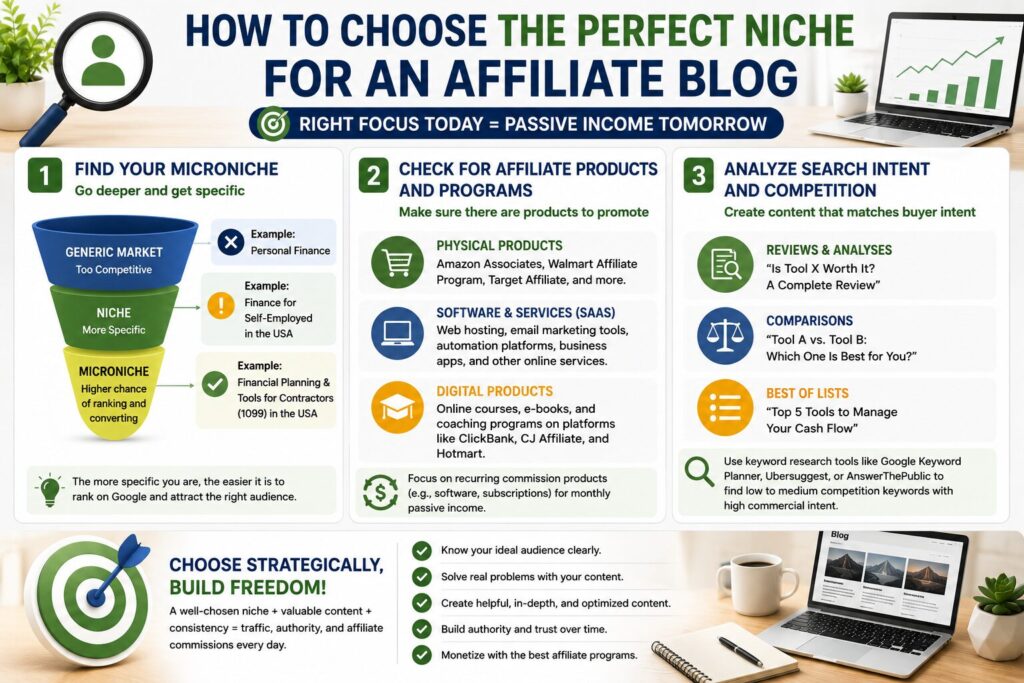
Step 1: Drill Down into “Micro-Niches” Within Massive Markets
Instead of attacking a broad, saturated market, take two deliberate steps inward and secure a specific sub-niche. Search engines favor domains that demonstrate hyper-focused Topical Authority within well-defined subjects.
Observe the funneling process in action:
- Generic Market: Personal Finance ❌
- Niche: Finance for Self-Employed Individuals ⚠️
- Ideal Micro-Niche: Financial Planning and Software Tools for Independent Contractors (1099s) in the US ✅
The sharper your initial focus, the easier it becomes to rank your articles on the first page of organic search results and capture highly qualified buyers.
Step 2: Audit the Availability of High-Converting Affiliate Products
Before purchasing your custom domain name and registering your web hosting package, conduct market research to map out the exact products and services you will review and recommend within your content.
Verify active affiliate opportunities across major platforms or specialized networks:
- Physical Goods: Amazon Associates, Walmart Affiliate Program, Target.
- Software & SaaS: Email marketing suites, web hosting platforms, automation tools, and management apps.
- Digital Products: Online courses, specialized e-books, and masterminds hosted on Hotmart, ClickBank, or CJ Affiliate.
Prioritize niches featuring recurring commission structures (such as monthly software subscriptions), where you earn a recurring percentage every month as long as your referral maintains an active account.
Step 3: Analyze Search Intent and Keyword Competition
To generate consistent affiliate sales, your readers must land on your site during the exact decision-making phase of their buying journey. Concentrate your early content production on articles carrying Commercial Search Intent.
Structure your initial content pipeline around topics like:
- In-Depth Product Reviews: “Is Software X Worth It? Full Features Breakdown”
- Side-by-Side Comparisons: “Software A vs. Software B: Which Is Best for Your Business?”
- Curated Recommendation Lists: “Top 5 Tools to Organize Small Business Cash Flow”
Utilize free keyword research tools (such as Google Keyword Planner, Ubersuggest, or AnswerThePublic) to verify that commercial search terms carry healthy search volume paired with low-to-medium competition scores.
Structured Digital Assets Deliver Long-Term Freedom
Mastering how to choose a niche for affiliate marketing removes guesswork from your digital strategy. Locking down the correct focus from day one saves months of wasted effort and guarantees that every published article functions as an automated asset working for your platform 24/7.
Consistent content output paired with strategic keyword targeting forms the engine of your digital growth. As your blog begins delivering steady organic traffic and predictable affiliate payouts, your next logical step is ensuring this new revenue stream is properly structured, organized, and legally shielded.
🛡️ Protect Your Digital Venture Cash Flow with ShieldPocket
Building profitable digital assets is the gateway to financial independence. Want to learn how to organize your multiple affiliate revenue streams, segregate business cash flows, and shield your growing digital wealth in the US?