

Building multiple streams of income is the smartest strategy to accelerate your emergency fund and shield your family. However, once the cash starts flowing in from various places—whether through freelance contracts, side hustles, or a small home business—a critical administrative chore arises: dealing with the tax season.
Many independent contractors and dynamic professionals end up paying way more in taxes than they legally owe simply due to a lack of core organization. Knowing how to report extra income strategically is what separates those who bleed cash from those who successfully protect their revenue to reinvest in long-term wealth.
In this guide, you will learn exactly how to organize your multiple revenues and stay compliant without overpaying the government.
The Biggest Mistake: Waiting Until Tax Season to Organize Receipts
When you receive a single W-2 paycheck, your tax accounting is done automatically. But when you manage multiple income streams, waiting until April to gather bank statements, invoices, and expense receipts is a clear recipe for financial stress and costly compliance penalties.
For anyone earning a flexible revenue, tax planning must happen month-by-month. Knowing exactly how much cash came in and, more importantly, how much it cost you to generate that revenue puts you in prime position to reduce your tax liability.
Step 1: Track and Claim Valid Write-Offs (Tax Deductions)
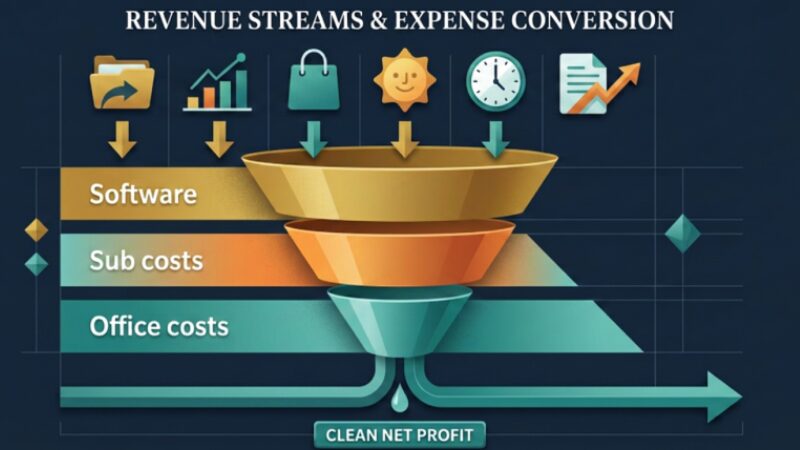
The golden rule for avoiding abusive tax bills on your side hustle gains is mastering the concept of tax write-offs. You are not required to pay income tax on your gross revenue, but rather on the net profit of your independent work.
To lower your taxable income base, you can deduct ordinary and necessary business expenses directly tied to your operations, such as:
- Digital subscriptions, software platforms, web hosting, and residential internet;
- Work equipment like laptops, smartphones, or specialized physical tools;
- Professional education courses and standard office supplies;
- Business mileage and fuel utilized strictly to visit or service clients.
Step 2: Keep Tabs on Thresholds and Pay Estimated Taxes
Depending on your local tax brackets, there are specific thresholds determining when you must start reporting self-employment earnings. Within the US market, any independent contractor or 1099 revenue exceeding $400 within a fiscal year must be reported to the IRS.
If your multiple income streams turn into a steady, significant revenue stream, do not wait until the annual filing deadline. Making quarterly estimated tax payments protects you from unexpected cash flow drain and eliminates underpayment penalty fees that the government enforces.
Step 3: Utilize Legal Business Structures (The Power of an LLC)
If your extra income is no longer a casual hobby and has turned into a predictable cash machine, continuing to operate strictly under your personal name (as a Sole Proprietorship) is often the most expensive route.
Establishing a simple legal structure, such as a Limited Liability Company (LLC), grants a massive double benefit:
- Asset Protection: It legally separates your personal belongings (like your family home and private accounts) from business risks and legal liabilities.
- Tax Efficiency: It opens doors for alternative tax classifications and allows you to streamline all business write-offs through a single, dedicated corporate bank account.
Organization Secures Cash Flow and Growth
Learning how to report extra income efficiently is not about breaking the rules—it is about utilizing the legal tax code to protect the cash you worked incredibly hard to earn.
Keeping your business accounting crystal clear paves the way for you to make major life milestones with confidence, such as securing home financing or scaling up your business ventures without worrying about unexpected tax audits.
🛡️ Protect Your Earnings and Future Cash Flow
Organizing your tax strategy is step one toward scalable growth. Want to discover how to align your multiple income streams with retirement accounts or specialized protection lines that provide exceptional tax incentives?
Click here to schedule a free consulting session with Leandro Santiago and build your financial protection plan today.