

If you recently migrated to the United States or decided to re-engineer your financial operations in America, you quickly noticed that the US market revolves around an invisible yet immensely powerful metric: your Credit Score. Carrying an excellent score dictates whether you can secure a long-term apartment lease without massive deposits, finance a commercial work truck under fair interest rates, or even establish baseline utility lines.
The primary structural myth that paralyzes most newly arrived professionals is assuming that starting this data-tracking process requires a Social Security Number (SSN). The technical reality of the US financial infrastructure is that you can seamlessly lay down your first foundational bricks and generate a top-tier credit score utilizing strictly an ITIN (Individual Taxpayer Identification Number).
In this tactical guide, you will master the exact step-by-step roadmap on how to build credit in the us from absolute zero, opening institutional doors for your commercial ventures.
What is an ITIN and How Does It Swap for an SSN in Credit Tracking?
An ITIN is a tax processing number issued by the IRS (the US federal tax authority) for individuals who are required to navigate US tax compliance but are not eligible to receive a standard SSN.
Major premier US banking institutions (such as Bank of America, Chase, and Citibank) alongside local credit unions fully accept an ITIN as a primary identification credential to open transactional checking accounts and issue credit facilities.
The core technical mechanism lies within the US credit bureaus (Experian, Equifax, and TransUnion). Their algorithms can successfully track your payment behaviors by cross-referencing your personal identification data tied directly to your ITIN ledger. When you eventually secure an SSN down the road, your historical track record built under the ITIN can be unbundled and legally merged into your new profile.
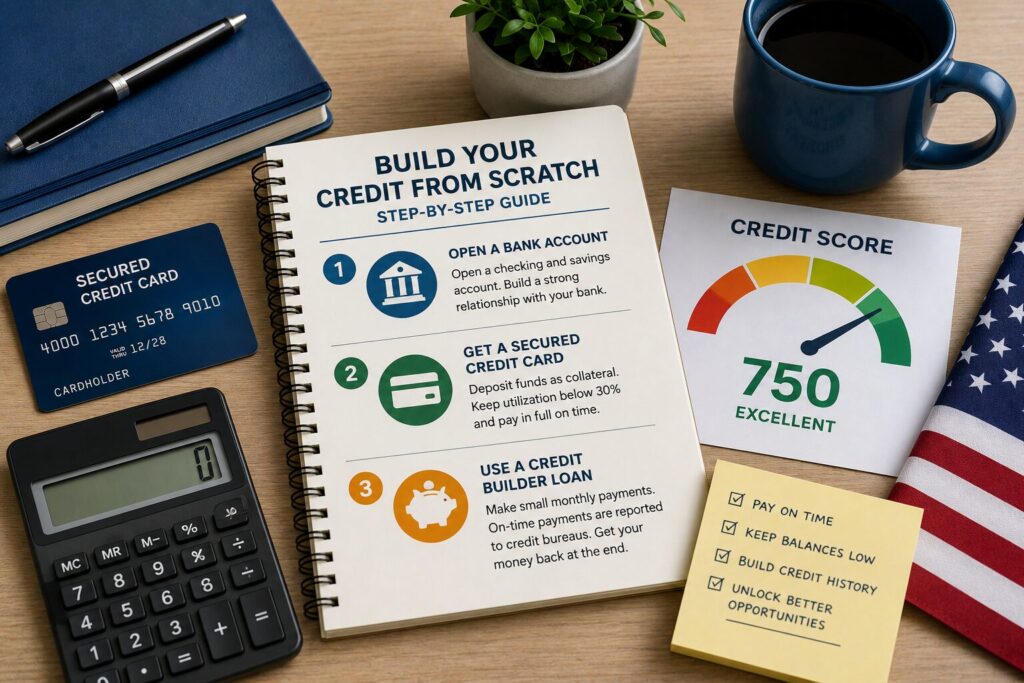
Step 1: Open a Checking Account and Establish a Banking Relationship
The opening milestone of your financial foundation is setting up a checking and savings repository with a recognized banking brand that interfaces with ITIN applications.
Depositing your multiple weekly settlements and executing clean account activity demonstrates baseline stability to the bank’s internal underwriting algorithms. Avoid overdraft events or bouncing physical checks at all costs. This initial internal relationship functions as the primary catalyst for getting approved for credit lines within that same institution in a matter of months.
Step 2: Acquire a Secured Credit Card
Because you possess no existing data footprint in the nation, traditional underwriters will not extend signature or unsecured credit lines right away. The optimal vehicle to break this technical bottleneck is a Secured Credit Card.
Under this setup, you provide a refundable security deposit to the issuing bank (e.g., $200 or $500), and the bank grants you a spending limit matching that exact collateral figure. The deposit acts as an absolute safety net for the financial institution.
The core execution strategy is simple: deploy this card exclusively for minor everyday transactions (like fueling your work vehicle or grocery runs), maintain a utilization rate under 30% of the total limit, and pay the statement balance completely and on time every single month. The bank reports this pristine timeline to the bureaus, kickstarting your scoring track.
Step 3: Utilize a Credit Builder Loan
Another highly effective, overlooked vehicle engineered for credit onboarding is a Credit Builder Loan, routinely offered by regional credit unions and specialized digital fintech platforms.
Unlike a standard commercial loan, you do not receive the lump sum up front. Instead, the lender locks the principal amount inside a protected savings account while you make minor, predictable monthly installments (such as $25 or $50).
Every single monthly payment is systematically reported to the credit bureaus as a positive, on-time loan obligation. Once the contract term matures, the lender unlocks the savings vault and hands the entire accumulated capital back to you. It operates as an exercise framework: you train your credit score while simultaneously forcing yourself to build a cash reserve.
The Launchpad for Big Moves in America
Learning how to build credit in the US from scratch is a process driven by strategic patience and data compliance. There are no shortcut mechanisms; the underwriting system rewards consistency and on-time execution over prolonged horizons. Within a window of 6 to 8 months of following these protocols, your first official score profile will be active and healthy.
Laying a strong credit score foundation is the primary variable required to minimize your operational living costs across the United States. Once you unlock access to low-interest capital pools, you secure the structural breathing room needed to expand your business margins. Your next logical upgrade is ensuring that all the new capital you build is legally insulated from liabilities.
🛡️ Protect Your Growth with ShieldPocket
Building robust credit history scales up your purchasing power and asset expansion. Want to discover how to properly insulate the wealth and properties you are unlocking in the US system using advanced protection frameworks?
Click here to schedule a free strategy consultation with licensed advisor Leandro Santiago and blueprint your secure financial future today.