

Managing household finances as a couple requires alignment, but when your revenue channels operate under opposite dynamics, the complexity increases. The scenario where one partner carries a steady, predictable corporate paycheck (W2) while the other operates as an independent contractor, relies on commission, or manages variable revenue channels is exceptionally common.
The most routine structural error couples make within this setup is enforcing rigid, equal-split arrangements (such as splitting every bill 50/50 on the first of the month), which triggers severe friction during months when market activity slows down for the independent earner.
However, when engineered with precision, pairing steady stability with variable expansion yields the ultimate financial foundation. In this tactical guide, you will master budgeting for couples with variable income using the Financial Anchor framework to build a stress-free household budget with high wealth-building leverage.
The Anchor and the Accelerator Concept
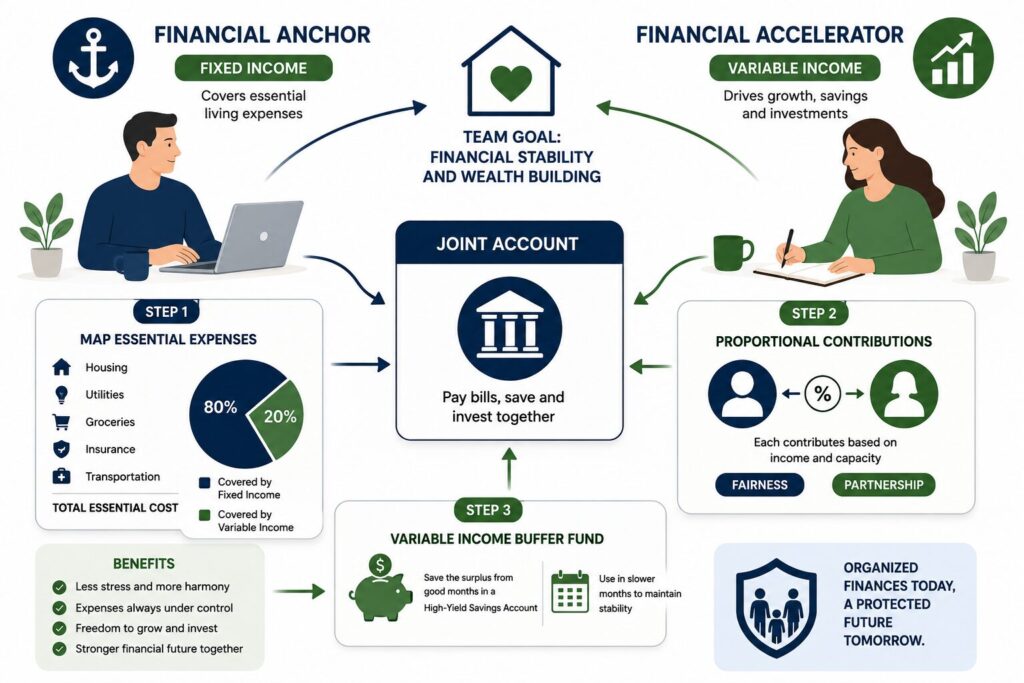
For household finances to run smoothly without relationship friction, incoming cash flow must be viewed as a single unified ecosystem divided into two distinct operational roles:
- The Anchor (Fixed Income): The steady paycheck functions as the household’s foundation. It should be strategically deployed to lock down the family’s core “Survival Baseline” (housing costs, essential utility invoices, and baseline groceries).
- The Accelerator (Variable Income): Flexible revenue acts as the growth engine. It covers variable living expenses, funds sinking accounts, fuels high-yield liquid emergency reserves, and accelerates long-term investment strategies.
This psychological partition removes pressure from the independent earner during slower market cycles and guarantees that non-negotiable household bills are settled on time, every time.
Step 1: Chart Your Family’s Baseline Survival Budget
Before determining who pays for specific line items, sit down together and map out your non-negotiable baseline budget. This total strictly covers expenses that cannot be eliminated: mortgage/rent, basic insurance contracts, primary utilities, and essential food.
If the Anchor’s fixed paycheck covers 80% to 100% of this baseline survival budget, your household security is structurally sound.
If the fixed paycheck covers only a portion of the baseline, establish a mandatory fixed minimum baseline contribution that the variable earner must deposit each month, directing all surplus funds from high-earning months into family reserves.
Step 2: Implement the Proportional Hybrid Account Model
Commingling all capital into a single joint checking account can cause operational confusion, while keeping finances 100% separated can misalign long-term family goals. The hybrid model offers the most efficient balance:
- Joint Household Account: A central vault where transfers are routed to cover monthly household liabilities and fund family investments.
- Individual Accounts: Each partner maintains an independent personal account to receive an agreed-upon “personal allowance”—guilt-free capital for individual discretionary spending without oversight.
Step 3: Build a Variable Income Buffer Vault
During high-performing months when variable revenue surges, do not inflate your standard of living. Overflow capital from strong months should be swept into a high-yield savings account (HYSA) labeled the Income Buffer.
When a slower month occurs for the independent contractor, execute a planned transfer from this buffer account to supplement the central household account. This creates the consistency of a steady paycheck across all 12 months of the year.
Strategic Unity That Builds Generational Wealth
Mastering budgeting for couples with variable income turns money into a tool that strengthens your relationship. The stability of a fixed paycheck provides the peace of mind required for the variable earner to innovate, secure higher-value contracts, and scale up business operations without the stress of meeting next month’s immediate bills.
Organizing your household routine lays the groundwork for family wealth. The next logical step to protect what you are building together is ensuring your accumulated assets are legally shielded against medical emergencies, disability, and taxation risks in the US.
🛡️ Shield Your Family’s Future with ShieldPocket
Couples’ financial planning lays the foundation for family legacy. Want to learn how to align your household budget with income replacement policies, living benefits life insurance, and US estate planning?