

For those working hard to build a life in the United States, purchasing a life insurance policy feels like the ultimate step toward complete peace of mind. After all, you agreed to a monthly financial commitment to ensure that if anything happens to you, your spouse and children will not face financial hardship.
However, the harsh reality of the US insurance market is that holding a policy does not automatically mean you are properly covered.
Too many policyholders purchase financial products without specialized technical guidance, making severe structural errors within their contracts. The result? At the exact moment your family requires liquidity, the insurance carrier denies the claim or issues a benefit payout far below what is actually needed.
In this strategic guide, you will explore the most critical mistakes when buying life insurance and learn how to adjust your coverage so your family’s protective shield remains completely unbreakable.
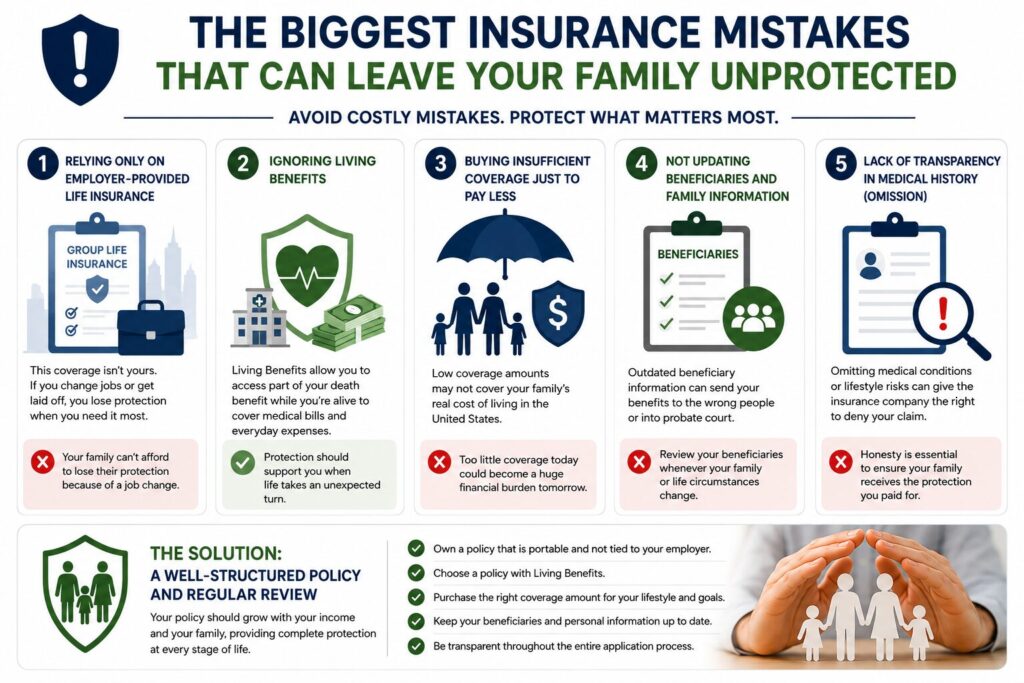
1. Relying Solely on Employer-Provided Group Life Insurance
Many professionals working for corporate employers depend exclusively on group life insurance offered as an employee benefit (typically covering just 1 to 2 times your annual salary).
The critical hazard of this setup is that you do not own the policy. If you are laid off, decide to change companies, or transition into launching your own independent service business, you lose your coverage instantly.
Furthermore, as you age, purchasing an individual private policy from scratch becomes significantly more expensive. Relying strictly on corporate group coverage means building your family’s protection on rented land.
2. Ignoring Living Benefits Coverage
The traditional view of life insurance is outdated: paying premiums your whole life so someone else receives cash only after you pass away. The most significant modern error is failing to insist on a policy equipped with Living Benefits.
If you suffer a heart attack, receive a cancer diagnosis, or experience a critical injury that keeps you away from work for months, who will pay your rent, mortgage, and monthly household expenses?
A policy featuring Living Benefits allows you to accelerate and access a substantial portion of your death benefit while you are still alive to cover medical bills and daily living costs, safeguarding your income while you focus on recovery.
3. Purchasing Inadequate Coverage Just to Save a Few Dollars
In an attempt to save a few dollars on monthly premiums, many people secure symbolic coverage amounts like $50,000 or $100,000. However, under the current US cost of living, that amount is completely depleted within months by rent, debts, and baseline expenses.
A reliable framework for calculating your ideal coverage amount must factor in:
- Capital required to eliminate structural debts (such as vehicle loans or mortgages).
- Income replacement for your household multiplied by 5 to 10 years.
- Future higher education expenses for your children.
A cheap policy that fails to cover your family’s actual survival baseline provides nothing more than a false sense of security.
4. Failing to Update Beneficiaries and Family Structures
When you secured your initial policy years ago, you might have been single or without children. Time passed, your family grew, but you never updated the beneficiary designation forms with the insurance carrier.
In the United States, primary beneficiary designations on an insurance policy override even what is stated in a legal will. If you fail to keep this data updated, the capital could end up in the wrong hands or fall into the lengthy court-supervised process of Probate, remaining frozen for months.
5. Lack of Transparency Regarding Medical History (Omission)
Attempting to hide a smoking history, pre-existing health conditions, or high-risk recreational activities during the underwriting process to secure a lower monthly premium is the most devastating mistake of all.
US insurance carriers maintain a Contestability Period (typically the first 2 years of the policy). If you pass away or file a claim within this window and the carrier discovers material misrepresentations on the initial application, they possess the legal right to rescind the policy and deny the death benefit payout entirely.
The Absolute Necessity of a Policy Audit
Avoiding these critical mistakes when buying life insurance is the difference between leaving a legacy of true protection or an inheritance of bureaucratic and financial distress for your loved ones. Your insurance policy must be a living asset, audited periodically to match the growth of your income and your family.
Correcting these gaps today costs infinitely less than what your family will have to pay if an unexpected emergency occurs tomorrow.
🛡️ Schedule a Free Policy Audit with Leandro Santiago
Are you certain your current policy includes Living Benefits, or that your coverage amount matches your family’s actual cost of living in the US?