

Stepping into the digital services marketplace or scaling your multiple income streams through independent contracting is an excellent wealth-building strategy. However, right after securing that very first prospect, almost every freelancer faces the exact same freezing question: “How much should I charge for this project?”.
Too many beginner freelancers make the critical mistake of guessing a price tag based entirely on what baseline competitors charge or what they feel the client wants to spend. The result? They end up working at a net loss, completely forgetting to factor in underlying software overhead and taxes. Mastering a data-driven freelance pricing strategy is what separates a casual hobby from a highly resilient, profitable side business.
In this guide, you will unlock exactly how to map out your real professional rates using a practical mathematical approach.
The Threat of Guesswork Pricing Models
Charging too little attracts difficult, micromanaging clients, depreciates the value of your time, and drains the vital energy you need to grow your core ventures. Conversely, throwing out random high numbers without knowing how to justify the breakdown will cost you excellent contractual opportunities.
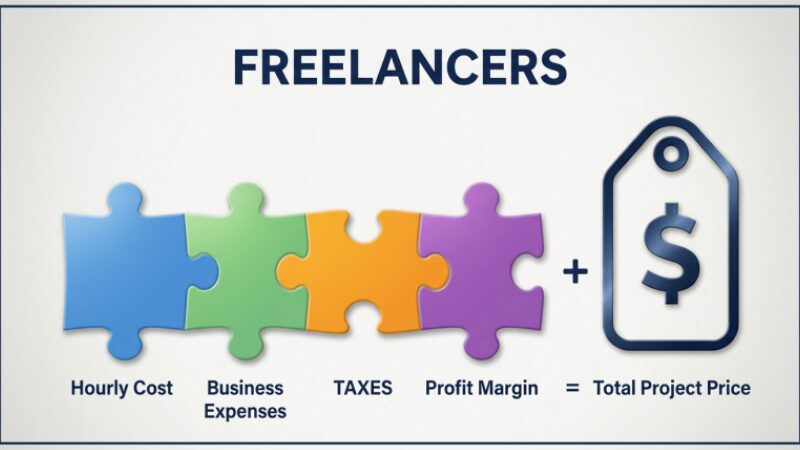
An efficient pricing setup must stand on concrete metrics: your fixed structural costs, self-employment tax liabilities, the value of your active hours, and the clean profit margin that returns to your business vault.
Step 1: Establish Your Cost of Living and Baseline Hourly Rate
When operating as an independent contractor, you must know what your minimum survival hour costs to keep the lights on.
- Sum your baseline household expenses: Gather your monthly essential living costs (rent/mortgage, groceries, transport, private insurance protection lines).
- Calculate your billable working window: Decide exactly how many hours per week you will realistically spend on client projects. Remember to calculate only billable hours (the time spent executing the client’s direct deliverables, excluding marketing or administrative tasks).
- Execute the math: Divide your core household costs by your monthly billable hours to unlock your raw “Cost Per Hour.”
Step 2: Factor in Business Operational Overhead
Your raw baseline hourly rate does not cover your entire infrastructure. A digital or home-based business carries hidden expenses that must be seamlessly factored into your client invoices.
To properly map your expenses, list out operational overhead such as:
- Professional software subscriptions (Adobe Creative Cloud, Canva Pro, SEO utilities, or CRM platforms);
- Web hosting packages, high-speed business internet, and domestic utilities;
- Hardware depreciation costs for your core gear (laptops, mobile units, specialized tools);
- Platform transaction fees or merchant processing cuts (like Fiverr, Upwork, or Stripe).
Step 3: Imbed Your Target Profit Margin and Tax Realities
A classic freelance pitfall is treating your personal living wage as the company’s net profit. Your hourly wage covers your labor time; the net profit is what allows your brand to reinvest, buy premium gear, or overflow into your asset protection fund.
Always apply a solid profit margin (typically ranging from 20% to 40%) directly on top of your calculated hourly costs. Furthermore, always imbed the estimated self-employment tax percentage you will face at the close of the fiscal year into the total invoice, guaranteeing that your net take-home cash is exactly what you planned.
Step 4: Pick Your Invoicing Framework (Hourly vs. Project-Based)
- Hourly Rates: Ideal for open-ended assignments where the client’s scope drifts constantly, or for long-term advisory and maintenance work. It guarantees you are compensated for every single minute deployed.
- Project-Based Fees (Flat Rate): Excellent for assignments where you have mastered your workflow execution times (e.g., building a targeted website, crafting 4 blog posts, delivering a specific graphic). If you optimize your speed, your net profit expands dramatically under this model, because you are billing for the value delivered rather than the raw hours clocked.
Value Your Time to Shield Your Future
Developing a clear freelance pricing strategy completely upgrades your position in the marketplace. Presenting a professional estimate backed by transparent metrics and clear margins projects true authority and gives you massive negotiation leverage.
Pricing your services fairly ensures that your multiple income stream journey remains highly rewarding and self-sustaining. The extra cash generated from your net profit should serve as the ultimate fuel to shield your hard-earned wealth and lock down long-term financial security for your family.
🛡️ Structure and Protect Your Side Hustle Profits Today
Accurate pricing generates the free cash flow required for long-term compounding growth. Want to discover how to seamlessly organize your freelance cash flows and implement specialized income protection lines that insulate your business activity?