

For anyone residing and working in the United States, the beginning of the year marks an inescapable and critical financial obligation: filing your annual tax returns. Understanding how this tax ecosystem functions is essential not only for maintaining compliance with US federal and state laws, but also for neutralizing IRS (Internal Revenue Service) audit penalties and ensuring you claim every legal deduction available.
A primary source of confusion for independent workers centers on the fundamental tax treatment differences between traditional wage earners (W-2) and independent service providers (1099).
In this practical breakdown, you will master how does tax return work in the us, identify mandatory filing documentation for both employment classifications, and organize your finances to navigate tax season smoothly.
What Exactly Is a Tax Return?
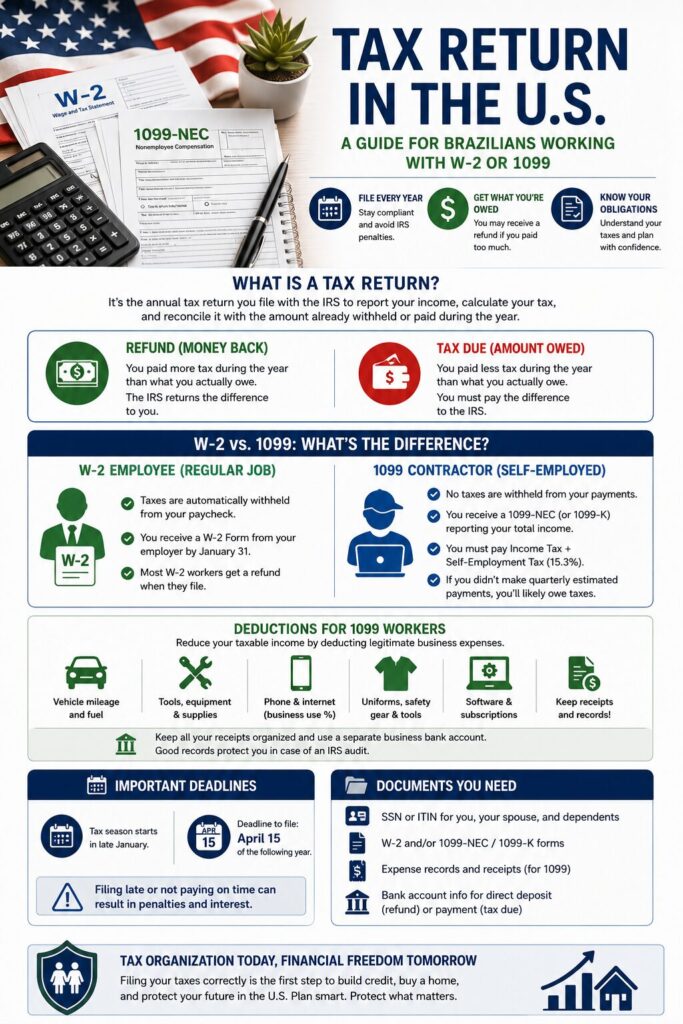
In the United States, a Tax Return refers to the official documentation submitted to the IRS and state tax authorities to report your total gross income from the previous calendar year, calculate your net tax liability, and reconcile that figure against taxes already withheld or remitted.
- Tax Refund: Occurs when the total tax withheld from your income throughout the year exceeds your calculated tax liability. The federal or state government returns the overpaid capital directly to your bank account.
- Tax Due (Balance Owed): Occurs when your total tax withholdings fell short of your actual calculated tax obligation. You must remit the remaining balance by the filing deadline to avoid interest accrual and late penalties.
W-2 Employee vs. 1099 Contractor: Key Tax Return Differences
Your worker classification fundamentally shapes how your taxes are calculated, withheld, and reported to tax authorities:
1. W-2 Employee (Traditional Wage Earner)
As a W-2 employee, your employer automatically calculates and deducts taxes from every regular paycheck. The employer handles automatic withholdings for Federal Income Tax, State Income Tax, and FICA taxes (Social Security and Medicare).
- Document Received: By late January, your employer issues Form W-2, detailing your total gross earnings and total taxes withheld.
- Typical Outcome: Because taxes were systematically withheld weekly, many W-2 workers qualify for a tax refund after claiming standard deductions or eligible credits like the Child Tax Credit.
2. 1099 Independent Contractor (Self-Employed)
When operating as an independent contractor, freelancer, or gig worker receiving 1099 forms, no taxes are withheld from your payments at the source. Clients issue gross payments without deductions.
- Document Received: Clients or payment processors issue Form 1099-NEC (or 1099-K) detailing total gross compensation distributed to you.
- Tax Responsibility: You are fully responsible for calculating and paying both Income Tax and the Self-Employment Tax (15.3% covering both employee and employer portions of Social Security and Medicare).
- Typical Outcome: If you did not make quarterly estimated tax payments throughout the year, you will likely face a balance owed (Tax Due) when filing your return.
Leveraging Business Deductions for 1099 Earners
The primary structural advantage of operating as a 1099 earner is the legal ability to apply ordinary and necessary business deductions (write-offs). Every dollar deducted from your business operations reduces your net taxable income.
Common eligible write-offs for 1099 contractors include:
- Vehicle mileage and job-related fuel expenses.
- Trade tools, specialized equipment, and supplies.
- Mobile phone and internet costs (proportional business usage).
- Work uniforms, safety gear, and trade software subscriptions.
Maintaining itemized receipts and operating out of a dedicated business bank account is essential for substantiating these deductions in the event of an IRS audit.
Filing Deadlines and Mandatory Documents
The official US tax filing season opens in late January, with the mandatory federal filing deadline typically falling on April 15th of the following calendar year.
Essential documentation required for filing:
- Personal Credentials: SSN or ITIN for all household members (taxpayer, spouse, and dependents).
- Income Statements: All issued W-2, 1099-NEC, or 1099-K forms.
- Expense Logs: Organized receipt records and mileage logs for 1099 operations.
- Banking Information: Direct deposit routing and account numbers for refund processing or tax payments.
Strategic Tax Compliance Builds Long-Term Wealth
Understanding how does tax return work in the us makes the difference between maintaining compliant financial operations or facing bureaucratic hurdles. Accurately declaring your annual income forms the foundation for building US credit history, securing mortgage approvals, and maintaining seamless immigration filings.
However, comprehensive financial strategy extends well beyond annual tax filings. The capital preserved through proper tax planning should be deployed to build emergency reserves and secure your family’s future.
🛡️ Secure Your US Financial Strategy with ShieldPocket
Annual tax filings represent just one component of your overall financial structure in America. Want to discover how to align your net income, protect your family against disability risks, and build tax-advantaged wealth using vehicles like Indexed Universal Life (IUL)?